

When you’re trying to eat healthier—especially if you’re managing blood sugar, inflammation, or gut health—it helps to know which protein sources give you the most support. That’s why we created a Protein Scoring Table that ranks foods based on three key things: health benefits, cost, and protein quality.
This scoring system makes it easy to compare different protein sources and choose the ones that are most balanced, affordable, and effective for your goals.
Our protein scoring system is built around three main pillars: health, cost, and protein quality. First, the Health Score (rated from 1 to 5) evaluates how beneficial each protein is for your body. To do this, we look at key factors such as nutrient density, anti-inflammatory properties, blood sugar impact, and gut health support—including whether a food provides fiber, prebiotics, or probiotics. The higher the health score, the more a given protein supports your overall wellness.
Next, we consider the Cost Score. This is where affordability comes into play. We calculate the average cost per ounce of protein for each food, ensuring a fair comparison between different sources. In our system, lower cost means a higher score, so affordable options are rewarded for being more accessible. It’s important to note that the more expensive the protein, the lower its cost score will be. This approach helps you spot proteins that offer the most benefit for your budget, allowing you to make smart, cost-effective choices without sacrificing nutrition.
Finally, we evaluate Protein Quality on a scale from 1 to 5. This score reflects how complete and useful the protein is for your body. We examine whether the food contains all essential amino acids, how easily it’s digested, and the amount of protein you get per serving. High-quality proteins score better here, ensuring your body gets what it needs for muscle repair, energy, and overall health.
By combining these three areas—health, cost, and quality—our scoring system offers a clear, balanced way to compare protein sources. Whether you’re looking for the healthiest, most affordable, or highest-quality protein, this system helps you choose foods that fit your needs and goals.
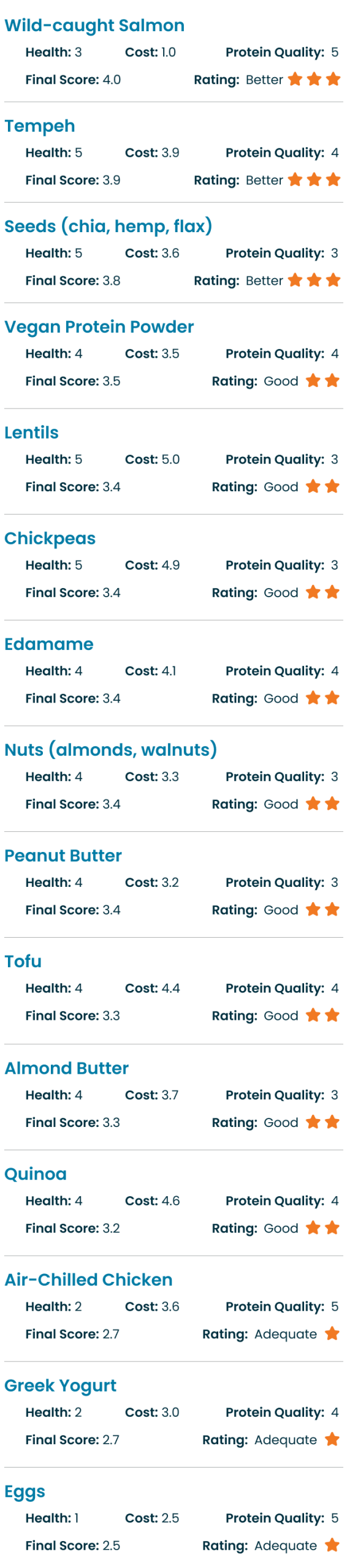
What Do the Ratings Mean?
★★★ Better: Final Score ≥ 3.8
★★ Good: Final Score between 3.2 and 3.79
★ Adequate: Final Score < 3.2
How We Score Each Food |
|---|
| We use a simple formula to combine all three scores:
Final Score=(0.5×Health)+(0.3×(6−Cost))+(0.2×Protein Quality)
|
Example: Spirulina
Let’s take spirulina as an example. Spirulina is a blue-green algae known for its impressive nutrient profile. It contains all nine essential amino acids, making it a complete protein, and it delivers a high amount of protein per calorie—more than most plant or animal sources. Because of this, it earns a health score of 5 and a protein quality score of 4. However, spirulina is also very expensive when you look at the cost per gram of protein. That brings its value score down, since our formula rewards affordability. With a cost score of 5.5, its value component is calculated as (6 – 5.5 = 0.5), which lowers its overall score. Using our formula: Final Score=(0.5×5)+(0.3×0.5)+(0.2×4)=2.5+0.15+0.8=3.45 This gives spirulina a rating of Good. It’s a strong choice for nutrient density and protein efficiency, but its high cost and limited serving size make it better suited as a supplement rather than a primary protein source. |



The LIVE TULA blog is informational and not medical advice. Always consult your doctor for health concerns. LIVE TULA doesn’t endorse specific tests, products, or procedures. Use the information at your own risk and check the last update date. Consult your healthcare provider for personalized advice.